We are always ready. We will never be ready.
That’s a paradox I’ll explore today.
There are always enough people saying either. Are they wrong? No. There’s no right or wrong when it comes to feeling ready. Feeling ready is a mindset.
Some people feel ready all the time, with or without preparation and practice. Others feel they’ll be ready once they finish just one more thing, and that one thing keeps changing, keeps shifting. This kind of thought is called a “thinking trap” in cognitive behavioural therapy.
And yet, we must be ready to be ready.
Before an exam, an interview, a match or a performance, which feeling is the better one to carry? Which one should I train my mind for? No one can answer that except you. It’s your mind, after all, and you are its trainer.
NLP reminds us that our inner state can be shaped and practised, much like a muscle. Swami Vivekananda said, “All knowledge must stand on perception of certain facts, and upon that we have to build our reasoning.”
So, here is a framework to help you understand your readiness quotient and build your reasoning for action. Here is my 4R framework.
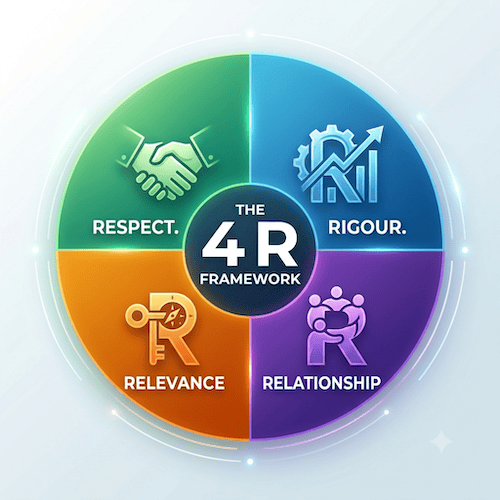
Respect
As a child, I found it hard to comprehend what was meant by the word ‘respect’. Was it the social gestures shown to adults, or was it the feeling of admiration I felt inside for some people, or was it the words I uttered? Was it for people only?
Time and experiences taught me that respect starts with honouring the life we have, the people around us (including ourselves), our unique privileges, different perspectives, biodiversity, and even the physical things we own. They are all worthy of care. The extent of care can differ, though.
Self-respect and mutual regard form the bedrock of emotional stability. When we start regarding them as important, they begin to work out for us. Respect helps establish healthy boundaries, fosters open and respectful conversations, builds valuable associations, and cultivates well-being.
- Respecting a thing: Say you have a book that you never bother to keep in a proper place, but toss it carelessly or leave it crumpled in a bag. What happens? It may get lost or torn and disappear from your life.
- Respecting people: Imagine a friend who trash-talks you behind your back, or downplays and trivializes your achievements. What happens if you stick around that dynamic for long? You start believing that person instead of your worth.
Respect is mutual, but it doesn’t mean holding people in high regard for being angry, brutal or harmful. It means we continue to respect their space, and our own. To each their own.
Ask yourself:
How am I showing respect for myself today?
How am I showing respect for others?
Rigour
A knife can be made of the finest steel, but if it sits unused in a drawer, it will gather rust and become far less effective than a simpler blade that gets used and sharpened every day. Likewise, you are talented. But the talent is not a magical quality. It is a dynamic strength in us, and using it sharpens it.
Strengths grow when we use them. The effort we put into anything, multiplied by our strengths, shapes the outcomes. Being thorough, detailed, careful, diligent and deliberate is at the centre of success.
This fits well not just for career goals but for everything we do in life. Think of something as simple as brushing your teeth. If you rush through it carelessly day after day, you don’t get the best out of our teeth, and eventually concerns develop.
Rigour is not only about the physical actions but also about setting our mindspace. It requires diligent mental deliberation to ensure the internal environment is organized, positive (resourceful), and attentive, as our thoughts shape feelings, and feelings shape what we do next.
Rigour isn’t trying to be perfect, but being your best.
Ask yourself:
Is this the best I can do right now?
Can I do something better, by myself or with help?
Relevance
Do you find what’s written above relevant to you?
Well, everything that’s happening around us need not be relevant to you. But the relevance of your learning, experiences, thoughts, actions, and presence helps you be you.
Relevance is an omnipresent concept, essential for success and growth. Being relevant to your present environment, to the people around you and to yourself can change perspectives, actions and outcomes.
Depending on your personal definition of success, relevance shifts. Often, people skip the relevance check or the “ecology check”—an NLP concept that asks whether a goal fits holistically into your life, before making major decisions. Sometimes skipping it doesn’t alter the tangible outcome or visible success, but it does alter the emotional impact we hoped for.
The story of Ajay: Take Ajay, a 14-year-old who has to finish his chapters this evening for an exam next morning. He also has a birthday party invitation for the same evening that he’s eager to attend. A quick relevance check helps him weigh immediate gratification against long-term impact. It also helps to ask what is really behind a choice. Is it my own value, or someone else’s expectation?
Ask yourself:
What makes it important right now?
What needs to be managed first, based on the impact it will leave on my life?
Relationship
Do you have a friend you care for but feel drained after hanging out with them?
Relationships can be healthy and detrimental, both. Awareness of which connection is which is critical to thriving.
People. An integral component of success and growth. And we are surrounded by all sorts of them. The kind of relationships we build, nurture and engage in shapes our outcomes: not just the tangible ones, but our emotions and mindspace too. Other people matter, and good relationships are one of the strongest foundations of a flourishing life.
A friend can push you up to grow, and a friend can pull you down. Telling them apart is challenging, because we can never predict what another person will do. But we can pay attention to how their company makes us feel, and evaluate to what extent we are okay with that feeling.
Every relationship has its own equation of respect and relevance. The degree of dominance of each can move the needle towards healthy or unhealthy or indifference, affecting growth.
Ask yourself:
Is there respect and relevance in this relationship?
Where do I draw my boundary?
No one can tell or decide for you how ready you are. It’s only you who knows.
Being conscious of the respect we give and get, the rigour we put in towards what we want, the relevance it holds for us, and the relationships we hold dear brings clarity and intention to our thoughts and actions.
And that may be the best kind of ready there is.

You must be logged in to post a comment.